The IBUS project makes buses lighter, more comfortable and more eco-efficient
03 October 2011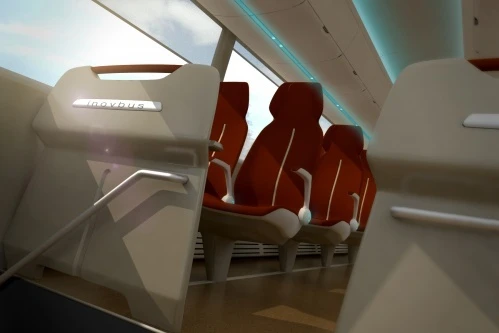
Cork, leather, design and engineered solutions to improve the travel experience on the buses of the future.
The IBUS Project, an innovative concept of eco-efficiency for designing systems and solutions for the interior and exterior of coaches is exhibited by a consortium formed by Caetano Components, Amorim Cork Composites, CORTICEIRA AMORIM, Couro Azul, SET and INEGI (Institute for Mechanical Engineering and Industrial Management), an organization under the umbrella of SCT (the National Science and Technology System), with the participation of Almadesign, a Portuguese design company and the monitoring by Caetanobus.
The full scale mock-up of the vehicle representing a section of a tour bus (2.4 metres long) will be exhibited at the Coach & Bus Fair in Birmingham, next 5th and 6th of October, as well as at the Biennale 2011 - International Conferences in Marinha Grande (Portugal) from 22 to 30 October 2011. The IBUS Project has been subject to tests and its performance stands out against currently existing solutions.
This project provides truly innovative solutions, some of which are inspired by aerospace and automotive solutions. Worth a special mention are:
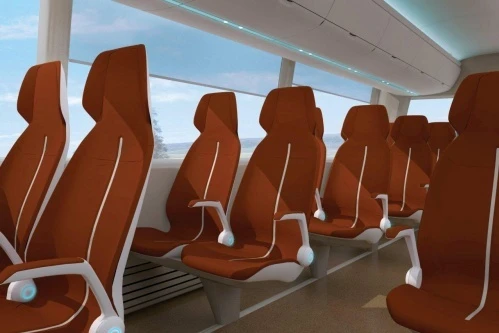
- Passenger seats: Ray and Shark - biomorphic design and low maintenance costs. The Ray seat is a comfortable and fine design seat, a precursor to future bus passenger seats combining light-weight with low thickness - resulting in greater seating capacity and/or comfort and safety - as well as seat belt sensors. The Shark seat is a high-end passenger seat, very comfortable and hugging, full of equipment and may be used in all existing bus bodies. Both the Ray and the Shark passenger seats are upholstered with ecological and anti-allergic leather, a material with a high resistance and easy to clean.
- Overhead locker system: an aircraft style lightweight overhead locker modular system with separate compartments and doors and an innovative locking system that significantly reduces assembly/maintenance costs.
- Lighting: a lighting system integrated into the overhead locker system and mimicking the format of the latter. The individual system is activated by a proximity system that does not require direct touch.
- Partition: thinner, which ensures greater safety and provides enhanced seating capacity and comfort.
- Overhead locker doors: Composite cork core doors contribute to increasing resistance rates up to 50% and reducing the weight of traditional overhead lockers; this allows for an easy handling of the doors and has a significant impact on the overall vehicle weight leading to improved performance.
- Side panels: Modular composite cork core side panels contribute to reducing the number of parts and drastically reducing assembly time, ensuring a more integrated result and improved thermal and acoustic insulation.
- Bus flooring: the traditional heavy plywood floor is replaced with a sandwich cork flooring, a lightweight and affordable solution with excellent thermal and acoustic insulation properties.
The levels of the vehicle's performance, stability and fuel consumption have benefited from the substantial reduction in the total weight of the bus, which lead to reduced operation and maintenance costs.
This project has been closely monitored by Caetanobus, a potential integrator partner. With a total investment of about € 1M, the primary aim of the IBUS project was to build a full scale mock-up of the vehicle representing a cross section of a bus to be shown at home and abroad. This project is funded in an amount of € 485 thousand by the ERDF/EU and the NSRF, under the aegis of the COMPETE - Operational Programme for Competitiveness Factors.