Value chain
Responsible production and consumption
In order to promote responsible production and consumption, Corticeira Amorim works with suppliers committed to adopting sustainable practices and favours those that adopt good ESG practices. The Organisation has a process for selecting, assessing and monitoring suppliers.
Corticeira Amorim has a verticalised business model that
spans all stages of production, from the purchase of raw cork,
inbound logistics and distribution (transport) to operations,
marketing and recycling of various products.
Corticeira Amorim intends to know in detail the behavior and practices of suppliers, preferentially selecting those that offer the best negotiation conditions and share the Company's principles and commitments, described in the Code of Business Ethics and Professional Conduct.
Recognising the potential impacts associated with its supply chain, the Organisation has a Procurement Policy and a Code of Ethics and Conduct for Suppliers, which set out economic, social, ethical and environmental criteria for the selection, qualification and assessment of suppliers. These instruments reflect Corticeira Amorim’s culture and values and set out clear expectations regarding human rights, working conditions, ethics and environmental protection, and are complemented by procurement procedures designed to mitigate potential negative impacts.
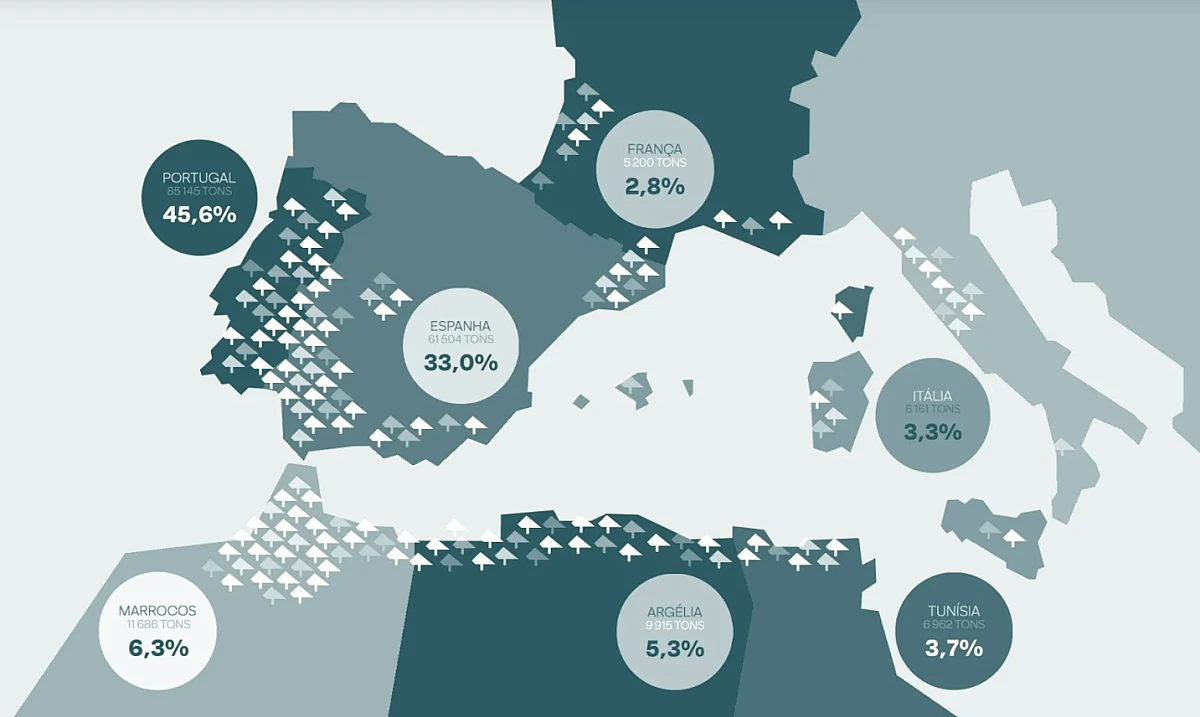
Cork is extracted without resorting to felling the trees, which can live for an average of 200 years.
Cork production takes place in the Mediterranean Basin and it is in this region that Corticeira Amorim's operations are mainly located, promoting the need for conservation and social and economic investment in these areas.
Corticeira Amorim pursues responsible purchasing practices in controlled areas, establishes medium- to long-term partnerships with cork suppliers and promotes compliance with the International Code of Cork Stopper Manufacturing Practice (ICCSMP) and forest certification, namely the Forest Stewardship Council (FSC®) certification, proving its concern and action in protecting biodiversity, the rights of employees, the rights of indigenous peoples and areas of significant environmental and cultural importance.
The IRSoc evaluates the supplier’s commitment and performance in matters of:
• Human and labour rights (including prohibition of child and forced labour);
• Non-discrimination and equal opportunity;
• Working, health and safety conditions;
• Compliance with applicable labour legislation;
• Existence of internal mechanisms for social management or recognised certifications (e.g. NP 4469, SA8000 or equivalent references).
The IRAmb evaluates the supplier’s commitment and performance in matters of:
• Legal environmental compliance;
• Waste, effluent and hazardous substance management;
• Efficient use of natural resources;
• Pollution prevention;
• Existence of environmental management systems or recognised certifications (e.g. ISO 14001 or equivalent).
The IRSoc and IRAmb indexes are calculated based on the percentage of requirements fulfilled by the supplier. Whenever the supplier holds recognised certifications, these may be considered as evidence of full or partial compliance with the corresponding requirements. Failure to meet critical requirements may lead to a reduction in the applicable index, the imposition of corrective measures, or, in more severe cases, the exclusion of the supplier.