Strategy and Management
Commitment
The definition of Corticeira Amorim’s strategic sustainability priorities is developed by the Sustainability support area, with the collaboration of other support areas, and involves a materiality assessment that takes into account the Company’s mission, vision and values, the evolution of the business, material impacts, risks and opportunities, as well as sustainability trends and benchmarks, changes in legislation, external commitments and internal policies, alignment with the Sustainable Development Goals (SDGs) and the needs and expectations of stakeholders.
Implementation is achieved through the involvement of top management and the teams responsible for implementation of sustainability initiatives
Corticeira Amorim has identified eight main groups of stakeholders: shareholders and investors, customers, workers, official and governmental entities, suppliers, media, non-governmental organisations (NGO) and the community, and partners and civil society.
Since 2009, Corticeira Amorim has been carrying out regular consultation and ongoing engagement processes with stakeholders, promoting their participation and integrating the results of the engagement processes, namely their concerns and expectations, into the definition of its sustainability strategy and materiality review.
This procedure, which is also part of the due diligence process, ensures that the main views and interests of stakeholders are communicated to the administrative, management and supervisory bodies, enabling them to monitor relevant external developments, understand market and stakeholder expectations and factor these inputs into the identification of risks, opportunities and strategic priorities.
In view of the commitment and ambition, Corticeira Amorim has identified 12 SDGs as priorities for its Sustainable Development Strategy: SDG3, SDG4, SDG5, SDG6, SDG7, SDG8, SDG9, SDG11, SDG12, SDG13, SDG15 and SDG17.
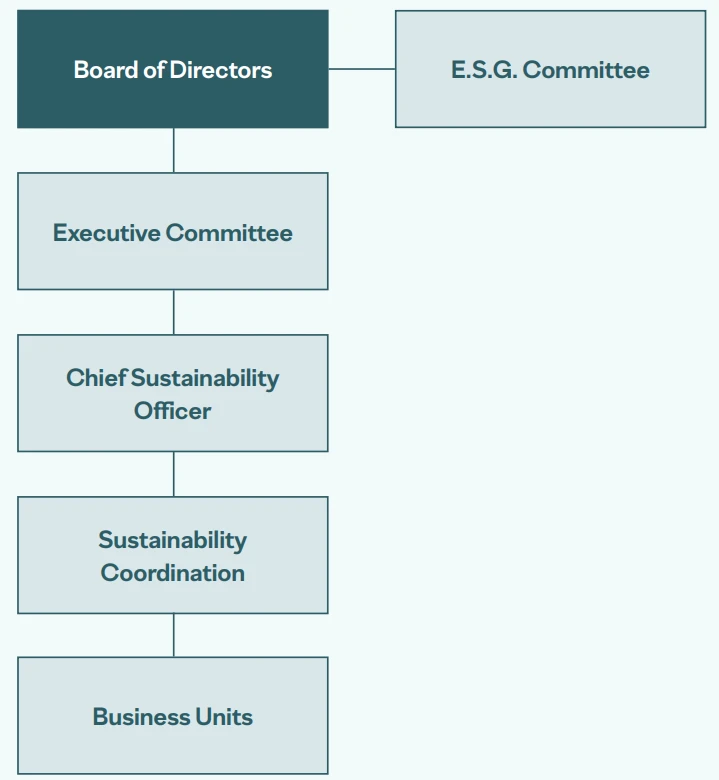
Corticeira Amorim’s Board of Directors, which includes the Chief Sustainability Officer (CSO), is responsible for promoting Environmental, Social & Governance (ESG) topics in the business, and approving the strategic objectives and initiatives and priority actions. The Executive Committee of the Board of Directors (ECBD) is responsible for overseeing sustainability issues and the integration of ESG issues into the business.
The Board of Directors has set up the ESG Committee (ESGC), a permanent specialised internal committee, which is responsible for providing advice, monitoring, supervision and strategic guidance to Corticeira Amorim in the field of corporate governance, ethics and environmental and social pillars. The committee’s attributions have been established in the respective Regulations.
The teams responsible for implementing sustainable development practices in each BU, implement the initiatives and actions that are necessary to meet the defined objectives and regularly monitor their performance. It is also up to them to identify and propose necessary actions to support the fulfilment of the defined objectives and goals, to carry out internal and external benchmarks to leverage organisational performance and to identify and propose new challenges.
Strategic sustainability priorities
Sustainable Development Goals
Act ethically, transparently and responsibly, in favour of competitiveness and the creation of sustainable value for all stakeholders and the planet
Our main goals
- Integrate measures related to climate change;
- Protect labour rights;
- Foster balanced and prudent management and sustainability;
- Be transparent and accountable;
- Sustain economic growth.
Reinforce responsible production and consumption, preferably selecting suppliers that adopt good ESG practices.
Our main goals
- Eradicate forced labour and child labour;
- Promote sustainable management and efficient use of resources;
- Strengthen partnerships for sustainable development.
Preserve the cork oak forest and ecosystem services by increasing knowledge, mobilising resources and proposing initiatives.
Our main goals
- Strengthen efforts to protect and safeguard cultural and natural heritage;
- Promote the implementation of sustainable forest management and mobilise resources;
- Integrate the values of ecosystems and biodiversity.
Reduce the environmental impact of operations through the adoption of renewable, affordable and efficient solutions.
Our main goals
- Increase the use of renewable energy;
- Improve energy efficiency;
- Reduce negative environmental impact.
Apply the principles of circular economy through the reduction of waste, extend the life of materials and regeneration of natural systems.
Our main goals
- Improve the efficiency of global resources, thereby achieving sustainable management;
- Manage the use of chemical products in an environmentally sound manner;
- Substantially reduce waste by reducing, recycling and reusing materials.
Ensure product safety and quality, support research, development and innovation, and promote sustainable solutions for all.
Our main goals
- Strengthen resilience and adaptability to climate-related risks;
- Upgrade infrastructure and rehabilitate industries to make them sustainable;
- Reduce negative environmental impact;
- Support productive activities, entrepreneurship, creativity and innovation;
- Enhance scientific research.
Encourage training and personal and professional development for all workers
Our main goals
- Ensure training for all;
- Value merit-based, judgement-free learning, development, recognition and compensation practices.
Ensure the safety, health and physical and psychological well-being of all workers, and promote appropriate work environments
Our main goals
- Promote safe and secure work environments for all workers;
- Provide access to essential quality health services;
- Reduce the number of workrelated accidents.
Leverage economic growth in a sustainable and inclusive way, ensuring efficient production and decent work for all.
Our main goals
- Sustain economic growth;
- Strengthen the global partnership for sustainable development.
Create an inclusive and diverse working environment, guarantee equal opportunities and fair pay, and adopt policies that eliminate discrimination and harassment in the workplace.
Our main goals
- Ensure equal access to opportunities;
- End all forms of discrimination;
- Protect labour rights.
Sustainability Management
The Board of Directors of Corticeira Amorim, comprising the Chief Sustainability Officer (CSO), is responsible for promoting ESG issues in the business, as well as approving the strategic objectives, strategic initiatives and priority actions.
The Executive Committee of the Board of Directors (ECBD) is responsible for overseeing sustainability issues and the integration of ESG issues into the business. The ECBD meets at least twice a year to analyse the approach to ESG issues, target setting, performance and reporting.
The Board of Directors has set up the ESG Committee (ESGC), a permanent specialised internal committee, which is responsible for providing advice, monitoring, supervision and strategic guidance to Corticeira Amorim in the field of corporate governance, ethics and environmental and social pillars. The committee’s attributions have been established in the respective Regulations. The ESGC is chaired by an independent non-executive member of the Board of Directors and is mainly composed of members of the Company’s corporate bodies, including the CSO, and includes the Head of Corporate Sustainability (HCS) as a permanent guest.