CORTICEIRA AMORIM commissioned a study on the life cycle of cork stoppers. The results show that natural cork stoppers are the best closure option for wine producers, distributors and retailers seeking to minimise their carbon footprint and adopt best practices in terms of environmental performance.
1. Challenges
- Study the environmental impact of the main alternatives to cork stoppers: aluminium caps and plastic closures;
- Compare the environmental impact, including CO2 emissions, of cork stoppers with that of aluminium screwcaps and plastic closures;
- Identify opportunities for improvement of the environmental performance of cork stoppers.
2. Context
The company:
CORTICEIRA AMORIM, S.G.P.S., S.A. is the largest producer of cork products in the world, with yearly sales of 495 million euros and clients in over 100 countries. Organised into five Business Units (BU) - Raw Materials, Cork Stoppers, Floor and Wall Coverings, Composite Cork and Insulation Cork - CORTICEIRA AMORIM offers a vast portfolio of high-quality products for use in industries as diverse and demanding as aeronautics, auto, construction, and winegrowing.
The market:
Increasingly, clients and consumers are demanding that companies provide information on the environmental and social impact of their products. In the major groups of the winegrowing and wine distribution sector, an ever greater commitment to good environmental practices and reduction of CO2 emissions, both of which result in a smaller carbon footprint, can be observed. In response to these concerns, CORTICEIRA AMORIM commissioned a study to investigate the environmental impacts associated with cork stoppers, plastic closures and aluminium screwcaps.
3. Approach
With the goal of comparing the environmental impact of cork stoppers with that of aluminium screwcaps and plastic closures, CORTICEIRA AMORIM commissioned a life cycle analysis for these products. This study, conducted in 2007 by PricewaterhouseCoopers, was carried out in accordance with the environmental management standards ISO 14040 (Life Cycle Assessment - Concepts and Applications) and ISO 14044 (Life Cycle Assessment - Requirements and Guidelines). The results of the study were published in October 2008 (to view the full study, click here).
In order to assess the potential environmental impact of the three different types of closure for wine bottles, the study examined seven environmental indicators. To comply with a requirement of the ISO 14040 standard, the least favourable scenario for the commissioner of the study - in this case CORTICEIRA AMORIM - was always used. Accordingly, whenever necessary, and specifically in the absence of information regarding non-cork closures, the results presented penalise natural cork stoppers.
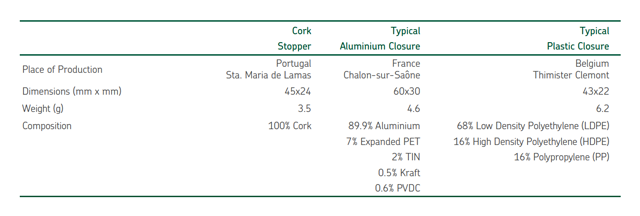
The study targeted closures used in 750 ml wine bottles consumed in the UK, and examined the following products:
4. Results
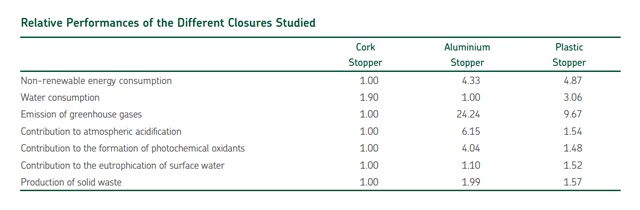
The cork stopper was considered the best alternative in six of the seven indicators used in the study, and was rated second in terms of water consumption.
With regard to greenhouse gas emissions, even without taking into consideration the carbon retention performed by cork oak forests, the study shows that less CO2 emissions are caused by cork stoppers than by plastic and aluminium closures. According to the study, each plastic closure results in around 10 times more CO2 emissions than a cork stopper, while the emissions caused by an aluminium screwcap are around 24 times greater than those of a cork stopper.

When the carbon retention of this ecosystem (the cork oak forest), made possible by the cyclical extraction of cork, is taken into account as stipulated by the OIV resolution on greenhouse gases, it can be concluded that each cork stopper is responsible for the retention of 112 grams of CO2, in stark contrast with the carbon emissions caused by alternative closures.
Considering the least favourable scenario for cork stoppers, i.e. excluding the carbon retention performed by cork oak forests, the table below summarises the relative performance of the different closures examined, with differences expressed in relation to the closure with the highest performance in each indicator.
Conclusion
The environmental performance of cork stoppers makes them the best choice for wine producers, distributors and retailers seeking to minimize their carbon footprint and adopt best practices in terms of environmental performance.